One workflow from intake to scoping
Locate the project, capture its activity and scale, screen the legal and spatial evidence, then record the preliminary pathway, referrals and scoping topics with a complete audit trail.
A decision-support platform for the relevant Authority of Ghana. Drop a pin anywhere in the country, declare what you want to build, and the tool returns the regulatory pathway under L.I. 2504 (2025) and the spatial environmental profile of the site — together, with the statutory citations.
Search a place, paste coordinates (decimal, DMS, UTM, Google URL, Plus Code), or click the map. Polygons supported.
Sector, sub-type, scale. Sector-specific fields prevent under-declaration. About 90 seconds.
Regulatory pathway + 20-indicator spatial profile + plausibility cross-check, on one screen, with sourced citations.
Every red/amber flag becomes a scoping topic for the EIS or EMP. Download the full PDF determination + Reg 29 letter draft.
Skip the form and see the tool fire on a known landmark — the result loads in a few seconds.
Give assessment officers one auditable view of the regulatory pathway, location-specific environmental constraints and required scoping topics — from project intake to preliminary determination.


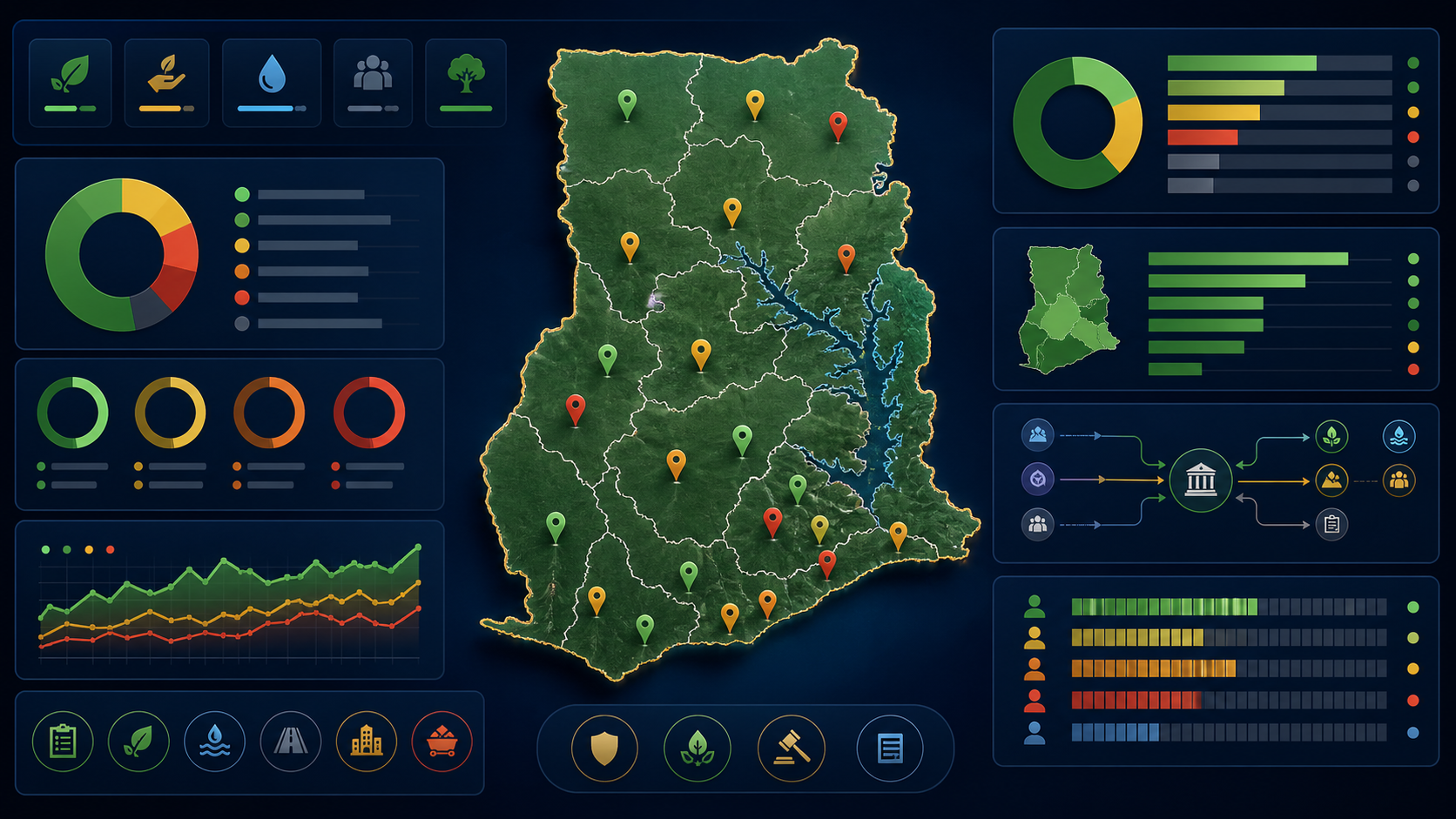
Screen the proposed locationOfficers see mapped environmental constraints, proximity findings and the preliminary regulatory pathway together.
Move consistently from intake to outputProject type and scale drive the legal pathway before spatial evidence, scoping topics and referrals are recorded.
Coordinate implementation nationwideAuthorized directors can review regional caseload, outcomes, statutory clocks and officer activity across Ghana.
Support officers with Ghana-specific legal rules, spatial evidence and documented scoping topics while retaining professional judgement and the Authority's statutory decision-making responsibility.
Locate the project, capture its activity and scale, screen the legal and spatial evidence, then record the preliminary pathway, referrals and scoping topics with a complete audit trail.
Authorized directors can monitor caseload, statutory clocks, sector patterns, regional activity and inter-agency referrals while operational details remain restricted by role.
An assessment officer (or an EIA consultant working with the Authority) completes the workflow on a single screen.
Search a place name, paste coordinates (decimal, DMS, UTM, or Google Maps URL), or pin the site directly on the map. Satellite and hybrid layers available.
Sector, sub-type, scale, and other dimensions drive the regulatory pathway. Sector-specific fields prevent under-declaration.
Regulatory pathway from L.I. 2504, spatial environmental profile from 20 indicators, plausibility flags from industry benchmarks — all on one card with full legal citations.
Every red or amber spatial finding generates a scoping topic for the EIS/EMP, linked to the relevant agency (FC, WRC, GRIDCo, Ghana Highways Authority). The officer signs the case off with a full audit trail.
Three layers of analysis, every screening, every site.
From L.I. 2504 First & Second Schedule, Act 1124, and the Act 1080 (2022) fee schedule. Determines requires_eia / requires_registration / requires_sea with full legal citations and indicative fee bands.
20 indicators evaluated at the project location: flood, wetland, river corridor, protected area, road setback, slope, seismic, soil, infrastructure, HT electricity ROW, galamsey, coastal erosion, contamination, groundwater.
Detects physically impossible declarations and order-of-magnitude scale mismatches (e.g. cement plant footprint too small for declared production). Tier-1 today; full benchmark engine in development.
Every red or amber finding auto-generates a scoping topic the EIS or EMP must address — linked to the responsible agency.
Statutory right-of-way under L.I. 542 (1967), as amended by L.I. 1737 (2004) — flags any project inside the 15 m corridor for 161 kV lines or 20 m for 330 kV. The only tool in Ghana that surfaces GRIDCo ROW conflicts at screening time.
Every decision is hash-signed with the inputs, rule version, data version, and officer signature. Defensible in court and before Parliament.
assessment officers run screenings; consultants prepare submissions; proponents understand what scoping topics their EIS must cover.
Primary users. Run screenings, assign cases, sign off decisions, monitor the 25/90-day statutory clocks, and track post-permit EMP submissions.
Pre-screen client projects before Authority submission; use auto-generated scoping topics to scope the EIS or EMP; submit completed scoping reports through the Platform for reconciliation.
Understand which permits apply, what baseline surveys are required, and what scoping topics the EIS must address — before engaging a consultant.
FC, WRC, Minerals Commission, Ghana Highways Authority, GRIDCo — referrals auto-routed when a project's spatial profile triggers their jurisdiction.
Every decision in the Platform is traceable to a statutory provision.
The Authority issues environmental permits under Act 1124 (2025) and the Environmental Assessment Regulations, 2025 (L.I. 2504). Statutory clocks: 25 days for screening, 25 days for scoping review, 90 days total decision.
Riparian buffer policy 10—100 m by stream order. WRC licensing for water abstraction, river setbacks, and discharge. Wetland delineation triggers when the spatial layer flags wetland proximity.
Forest reserves and off-reserve areas. Clearance required for any project in or adjacent to a Forestry Commission gazetted area.
Transmission Line Protection Regulations. Construction prohibited within 15 m of a 161 kV line or 20 m of a 330 kV line. The Platform flags ROW conflicts before submission.
This tool is decision-support software offered to the relevant environmental assessment Authority of Ghana. It does not issue environmental permits, does not constitute a determination by any Authority, and does not replace the statutory functions of assessment officers, the Director-General, or the Board.
Every output is advisory. The legal force of any environmental decision derives solely from the Authority's formal act under Act 1124 (2025) and L.I. 2504 (2025).
The Platform composes data from the regulatory pathway engine and a 20-indicator spatial environmental screening engine. Third-party datasets may contain inaccuracies or be outdated. Findings should be verified by the responsible officer before any permit decision.